
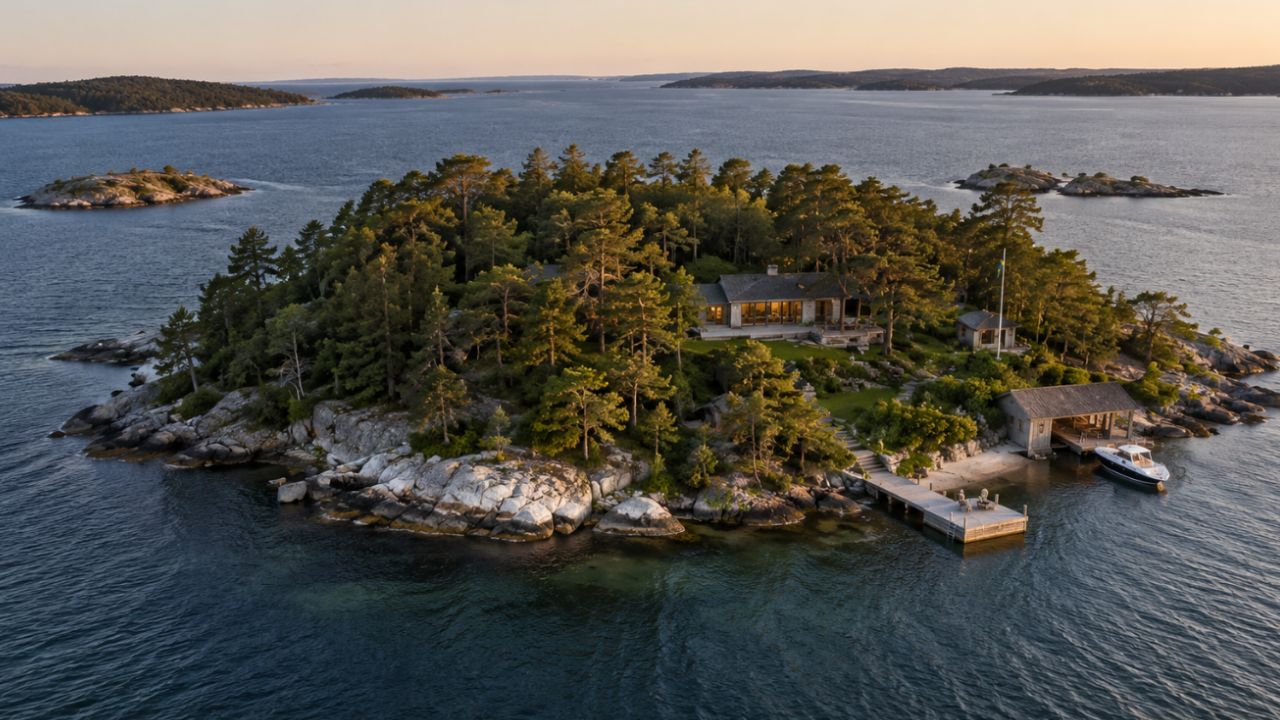
Owning a private island is one of the ultimate symbols of wealth: empty beaches, no neighboring properties and the possibility of literally calling a piece of the map your own. But there is one less glamorous detail in this fantasy. Buying the island may be only the beginning of the bill.
The market is surprisingly broad. According to Private Island Market, a private island can cost from around US$50,000 to more than US$100 million, while the median price of international listings falls in the US$2 million to US$5 million range.
The problem begins when the new owner decides to turn an isolated piece of land into a truly habitable place.
Water, power and even the dock can cost a fortune
On an island without infrastructure, practically everything has to be built from scratch. Electricity, drinking water, sewage treatment and boat access all come before even thinking about an infinity pool or designer interiors.
Data from Private Island Market estimates that a residential solar power system can cost between US$55,000 and US$90,000, while larger systems can reach US$250,000. A reverse-osmosis desalination system can exceed US$200,000 for residential installations and surpass US$800,000 in larger projects.
Even docking a boat can become a substantial investment: depending on the size and conditions of the site, a fixed dock can cost hundreds of thousands of dollars.
Construction is also more expensive. Materials have to arrive by boat, workers may need to be transported and accommodated, and any logistical setback becomes more significant. As a result, construction on islands can cost between 1.5 and three times more than equivalent projects on the mainland.
And the bills keep coming every year
Even after everything is built, the island continues to demand money.
Private Island Market estimates typical annual expenses at approximately US$84,000 to US$310,000, including taxes, insurance, maintenance, staff, transportation and upkeep of energy and water systems. On larger and more sophisticated properties, the bill can exceed US$500,000 a year.
There is a simple reason: an island cannot simply be abandoned while the owner travels.
An employee or a caretaker couple may be needed to look after the property, monitor storms, maintain gardens, check equipment and ensure that docks and buildings remain usable. Saltwater, humidity and tropical vegetation make maintenance virtually constant.
Transportation also enters the equation. Boats need fuel, insurance and maintenance; on extremely remote properties, helicopters and seaplanes may become part of the logistics.
Exclusivity comes with a hidden price
In the end, the real luxury of a private island is not simply buying it. It is being able to recreate, in the middle of the ocean, conveniences that would normally depend on an entire city.
Running water, 24-hour electricity, internet, staff, food arriving in the kitchen and a boat ready to leave whenever necessary.
The view may be heavenly. But keeping paradise running is probably the most expensive part of the story.
+ Video: Brandi Love shows before and after of her makeover for Vixen party
+ George Clooney tried to help Presley Gerber before his death at 27, report says
This content was created with the help of AI and reviewed by the editorial team.