
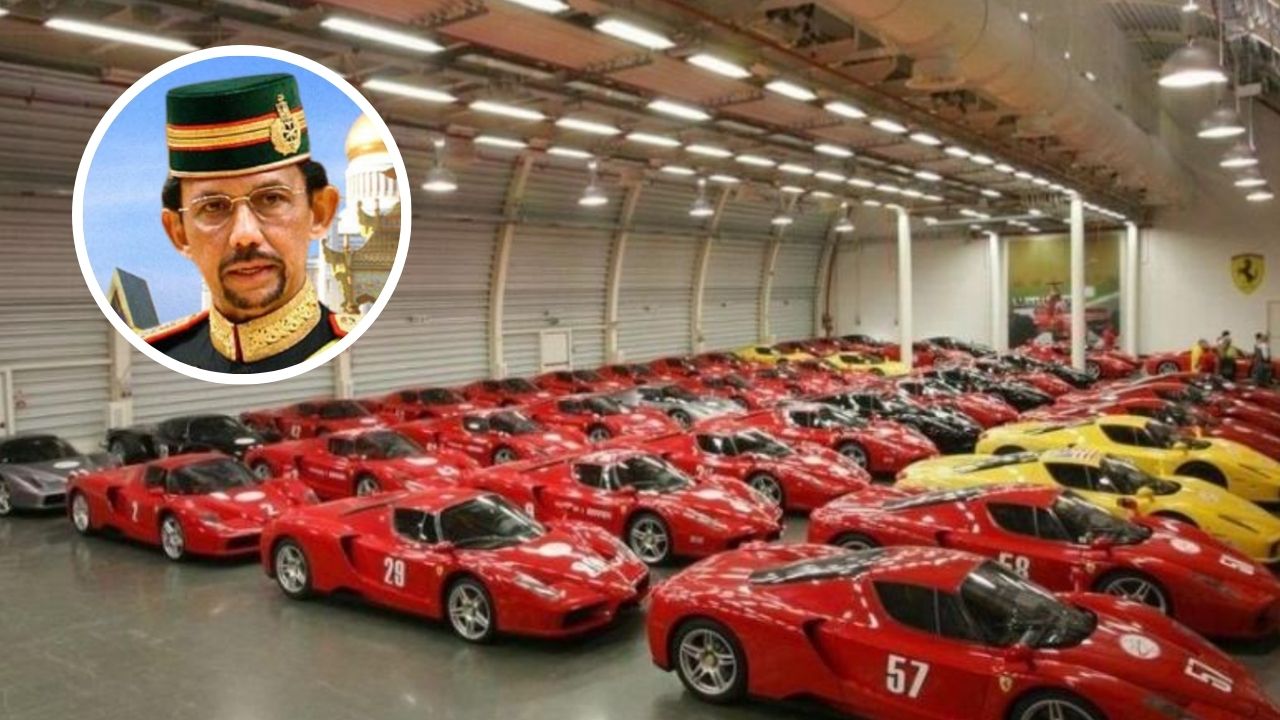
Guarded by dogs and armed personnel, an ultra-secret room belonging to the Sultan of Brunei houses some of the rarest and most mysterious cars ever produced.
+ 4 luxury cars that could get cheaper in 2026 — is it worth waiting?
According to the website Luxury Launches, around 25 years ago a man managed to gain access to this space of the Sultan of Brunei armed with nothing more than a rudimentary digital camera, recording 28 experimental Ferraris and Bentleys that, officially, should never have been seen by the public.
For decades, the Sultan of Brunei discreetly assembled what is widely considered the largest private car collection on the planet. There are thousands of vehicles — many customized, experimental, or never commercially sold — spread across a fortified complex of royal garages in Jerudong. Within this already inaccessible collection, however, there exists an even more restricted space, surrounded by myths and speculation among enthusiasts: the so-called Black Room.
The access to the Sultan of Brunei’s room that changed everything
What sets the Black Room apart from mere rumors is an extraordinary episode that took place in December 2001. According to accounts compiled by Luxury Launches, a single enthusiast received authorization to enter this ultra-secret environment alone, carrying a Canon PowerShot G1 with 3 megapixels — advanced technology for the time.
For two hours and twenty-six minutes, he moved through the space in an almost erratic manner, stopping, turning back, and wandering without a defined route. By the end, he had taken 148 photographs. Of these, 121 were released to the public years later, as noted by Bentleyspotting, becoming the primary — and virtually only — visual source about the location.
These images sparked obsessive analysis. Enthusiasts even combined them into an approximate digital model, reconstructing the photographer’s path and creating a detailed map of the room. One of the cars appears only in the background of a single image, a result of the irregular route — a detail that became an internal curiosity among specialists.
The low resolution, deep shadows, and blown-out highlights turned the photos into true visual enigmas, fueling meticulous debates for years.
A museum staged in darkness
The Black Room of the Sultan of Brunei resembles no conventional storage space. It is a completely dark gallery, with no windows, where the walls, ceiling, and carpet are entirely black. Each car is isolated under an individual spotlight, floating in the darkness like a carefully staged work of art.
Located on the upper floor of one of the garage blocks in Jerudong, the room is often referred to as a “museum” by local archivists. Nothing appears simply parked. Everything seems deliberately displayed.
The cars that should not exist
Based on reconstructions of the 2001 visit, there were 28 cars in the Black Room of the Sultan of Brunei at the time. Nineteen were Bentleys, five Ferraris, three Aston Martins, and one McLaren F1. Of these, 27 were unique one-off examples built exclusively on commission for Brunei. The McLaren F1 was, curiously, the only production model present in the space.
On the Bentley side, the collection appears to tell an alternative history of the brand. The Java Estate models emerge like ghosts of a smaller Bentley that never existed — luxury shooting brakes decades ahead of their time. The Rapier coupes, meanwhile, anticipated the proportions of the Continental GT years before Bentley officially pursued that direction.
The Phoenix convertibles, with clear Italian influence, reveal how design studios quietly shaped the future of the brand to satisfy a single client. Spectres, Grand Prix cars, and an extensive family of variations based on the Continental R demonstrate that these commissions went far beyond luxury: behind the scenes, they financed real advances in design and performance.
Ferrari’s boldness in Brunei
On the Ferrari side, the historical impact may be even greater. As detailed by Luxury Launches, the Ferrari FX projects were financed by Brunei and designed by Pininfarina as evolutions of the 512M. The key difference, however, lay in the transmission.
Each FX was sent to Williams to receive a seven-speed sequential gearbox derived from Formula 1 technology — years before paddle shifters became standard on road-going Ferraris. One of these models eventually left Brunei and resurfaced in California, where chronic clutch problems revealed just how experimental the project truly was.
Alongside them appear the Ferrari F90 berlinettas, cars that Ferrari itself never officially acknowledged, built exclusively to order. The road-going Mythos blur the line between concept and production, while the 456 Venice shooting brakes show how far Maranello was willing to go to satisfy the client. There are even records of a 456 equipped with an infrared night-vision system — proof that experimentation went beyond design.
The power of secrecy
What gives the Black Room its lasting fascination is not only the rarity of the cars, but absolute control. The complex is protected by barbed wire, armed guards, dogs, and strict access rules. Passports are retained. Escorts are mandatory.
Inside the Black Room of the Sultan of Brunei, lighting both conceals and reveals. Details vanish into the shadows, shapes turn into suggestions. That is why the solitary two-hour walk with a primitive digital camera remains more significant than any official statement.
These imperfect images remain, to this day, the clearest window into the most secret room of the most secret car collection ever assembled.
Source: Luxury Launches. This content was created with the help of AI and reviewed by the editorial team.
Ver essa foto no Instagram