
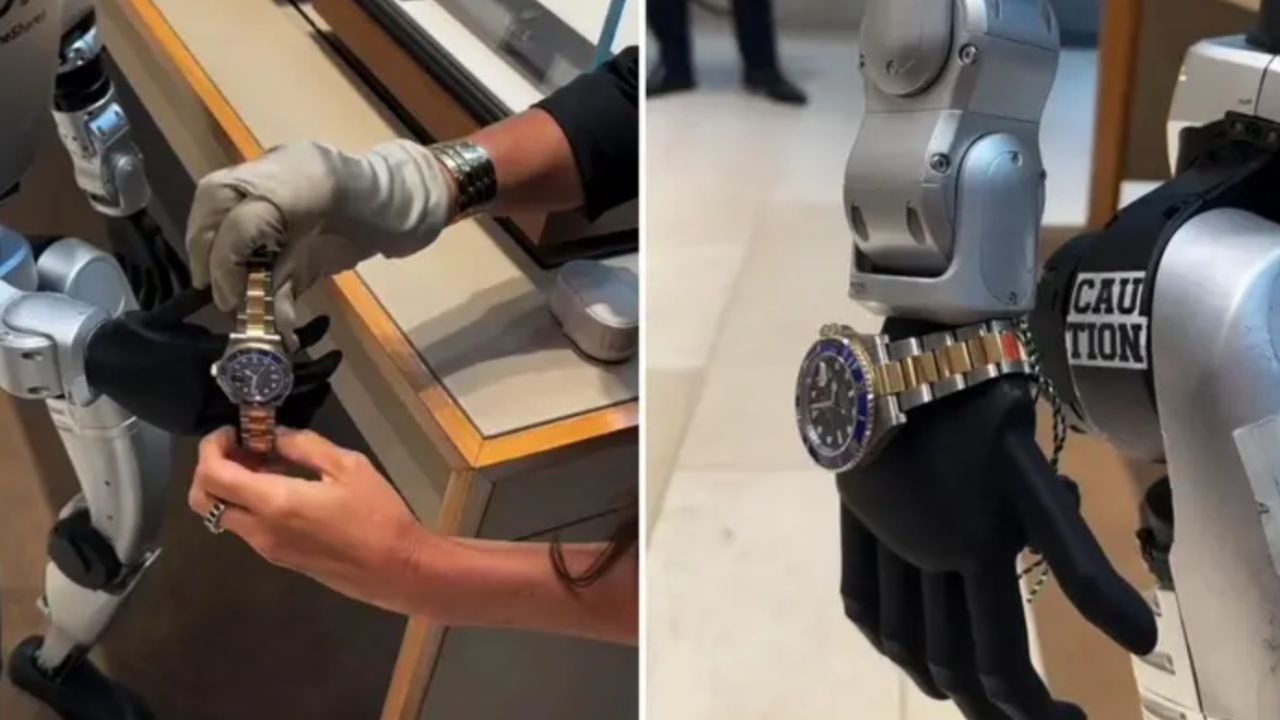
On New York’s Fifth Avenue, a surprising scene stopped pedestrians and went viral on social media: a humanoid robot worth $100,000 walked into the Rolex boutique and asked to try on a GMT-Master II model.
+ 8 strange rules you must follow in Paris (yes, they exist!)
The robot’s appearance at the Rolex store sparked debates about technology, artificial intelligence, exclusivity, and the role of humans in the algorithm age.
When artificial intelligence enters the luxury world
The robot, named KOID, is an advanced engineering creation from China. Valued at around one hundred thousand dollars — the equivalent of two fully equipped Tesla Model 3s — KOID impressed by walking fluidly down the iconic Fifth Avenue, waving to passersby and entering the Rolex store just like any high-end customer would.
But KOID wasn’t there by chance. The event was part of a marketing campaign by KraneShares to promote its Global Humanoid and Embodied Intelligence Index ETF, a fund focused on advancements in robotics and AI. The initiative was carefully orchestrated to generate buzz — and it succeeded.

Mixed reactions: fascination or discomfort?
Inside the Rolex boutique, known for its strict service policies, the sales team was faced with a “customer” who doesn’t breathe but knows exactly what he wants. With precise sensors and realistic movements, KOID examined the environment and pointed straight at the coveted Rolex GMT-Master II — a model that symbolizes status, achievement, and exclusivity.
The scene, filmed and widely shared, generated strong reactions. Some New Yorkers laughed. Others were visibly unsettled. One man even shouted, “Satan, I rebuke you to hell!” according to the New York Post. Another asked sarcastically, “How much is the robot getting paid and how much am I making?”

What KraneShares’ marketing really provoked
KOID’s visit to Rolex was more than a bold marketing move. It was a social experiment that touched on current issues: who has access to luxury? What does exclusivity mean when a robot can walk into an elite boutique — no line, no purchase history — and be treated like a VIP?
Joseph Dube, KraneShares’ Chief Marketing Officer, explained, “Some people were terrified. It was a huge mix of reactions.” That was the company’s goal: to provoke reflection on the future of consumption in an increasingly automated world.
Rolex, AI, and the redefinition of desire
Rolex — a traditional symbol of ambition and patience (after all, many wait years for specific models) — was the perfect stage for this narrative. There’s something almost profane about seeing a humanoid robot “cut the line” and fasten a luxury timepiece to its titanium wrist.
This clash of realities raises the question: are we ready to share the luxury space with artificial intelligence? And more importantly: can technology be a customer? Can it desire?
The future is already trying on its Rolex
More than just a watch, KOID tried on the future itself. The scene symbolizes a new era where luxury, technology, and status are intertwined in ways previously unimaginable. Whether you’re an innovation enthusiast or a traditionalist, one thing is certain: 2025 will be remembered as the year AI walked into a Rolex store — and no one left unscathed.
Source: Luxury Launches. This content was created with the help of AI and reviewed by the editorial team.
Ver essa foto no Instagram
