
In the world of hypercars, where technology, exclusivity, and cutting-edge engineering go hand in hand, few would dare to go against the manufacturer of the Bugatti Chiron, a model valued in the millions of dollars.
+ The most talked-about watches of Super Bowl LX 2026
But that is exactly what happened when a crashed Bugatti Chiron ended up at the center of one of the most talked-about episodes in the recent automotive world.
The person responsible? British automotive content creator Mat Armstrong, known for restoring supercars considered “lost causes.” This time, however, the challenge was on another level: structurally dismantling a Chiron — something that, according to Bugatti itself, could only be done at a very limited number of authorized centers around the world.
An Elite Hypercar Outside the Official Network
The Bugatti Chiron is one of the most sophisticated machines ever produced. With a quad-turbo W16 engine, engineering based on a carbon-fiber monocoque, and a price tag exceeding $4 million, it represents the peak of the modern automotive industry.
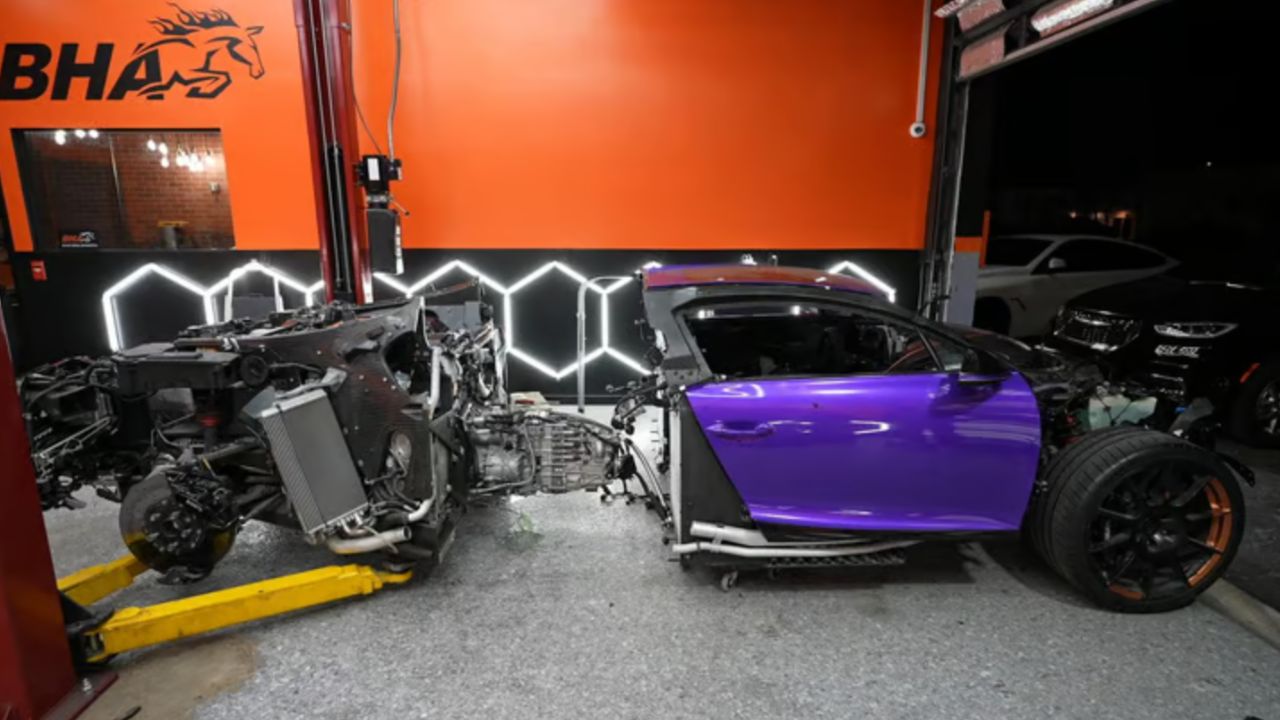
After a significant accident, the model in question required a complex technical procedure: structural separation between the front and rear sections to access the transmission assembly and the structural core.
According to information published by the website Luxury Launches, Bugatti reportedly stated that only two facilities in the world had the tools and certification necessary to safely carry out this process.
That did not stop Armstrong.
Alternative Engineering: Creativity Versus Exclusivity
Without access to the brand’s official equipment, the YouTuber developed his own solution in his workshop. Using a conventional automotive lift and adapted structures — including the reinforced base of an industrial container with casters — he managed to support and separate the sections of the hypercar with precision.
The procedure was not reckless improvisation. On the contrary, it involved structural calculations, analysis of mounting points, and careful dismantling of the carbon-fiber bodywork.
The result was the complete exposure of the Chiron’s internal architecture — something rarely seen outside the manufacturer’s behind-the-scenes environment.
What Was Revealed After the Dismantling
With the vehicle structurally separated, the extent of the damage became clear:
- An aluminum structural support connected to the transmission assembly was fractured.
- Components of the cooling system showed deformation.
- Despite the severe impact, the engine block and main transmission did not suffer catastrophic failure.
The dismantling made it possible to assess the model’s real recovery potential — and contradicted initial predictions of a total loss.
Tension With the Manufacturer
According to the original report from Luxury Launches, the vehicle identification number was initially blocked by the brand to prevent parts from being supplied outside the authorized network.
The impasse generated international attention and sparked debates about the right to repair, technical exclusivity, and manufacturers’ control over products that have already been sold.
Later, the situation evolved, and the manufacturer reportedly revised its stance regarding the supply of components.
Much More Than a Repair
This episode goes beyond the restoration of a hypercar. It touches on central issues in the luxury industry:
- To what extent should ultra-exclusive brands control the maintenance of their products?
- Is contemporary engineering truly inaccessible outside the factory?
- Is the maker culture beginning to challenge the traditional hierarchy of the premium automotive sector?
The Bugatti Chiron has always been a symbol of extreme performance and absolute sophistication. Now, it also enters history as the protagonist of a debate about access, engineering, and autonomy in the most exclusive segment of the automotive world.
Article based on a report published by the website Luxury Launches.
This content was created with the help of AI and reviewed by the editorial team.